
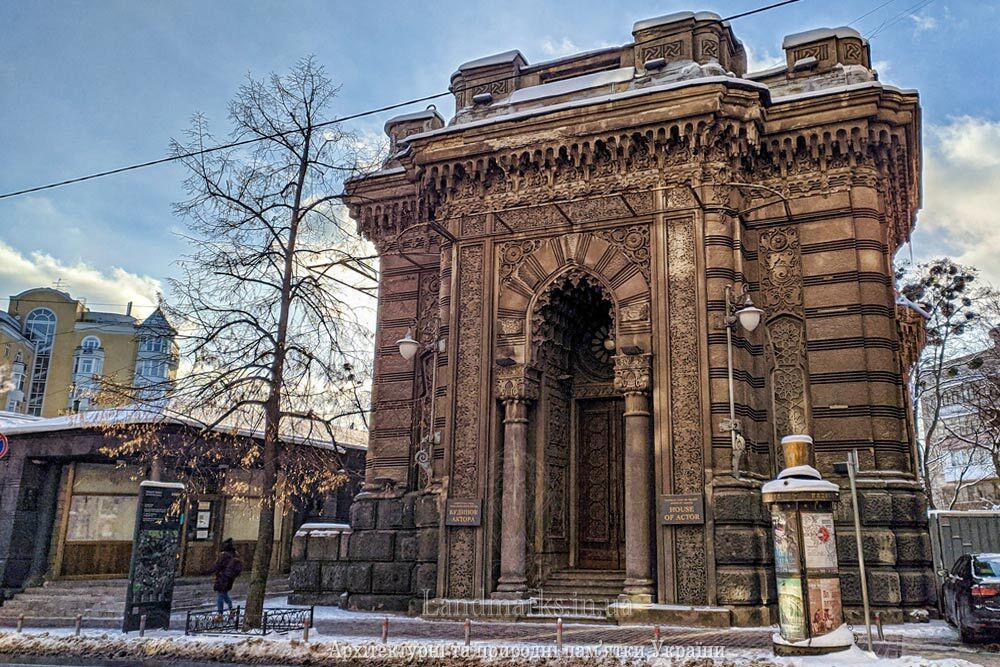
Oriental Tale in Concrete: A Complete Guide to the Karaite Kenesa in Kyiv 🏰🕌✨
Kyiv is a city where a whole universe is hidden behind every turn of a facade. However, there is a point on the map of the capital that can transport you thousands of kilometers south, to sunny Morocco or majestic Granada. This is the Karaite Kenesa, located at 7 Yaroslaviv Val Street 📍. This building is not just a landmark; it is the history of one of the most mysterious peoples in the world, embodied in concrete.
Who are the Karaites: People of the Book and Traditions 📜🏺
To truly appreciate the beauty of the Kenesa, you need to know who the Karaites are. They are one of the smallest ethnic groups on our planet. Their name comes from the Hebrew word "qara," which means "to read." Karaites call themselves "People of the Book," because their faith is based solely on the sacred text of the Old Testament, rejecting all later interpretations 📖.
Karaites began to move to Kyiv en masse in the 19th century, mostly from Crimea and Lutsk. Although their community was never huge (at its peak it numbered about 800–1000 people), they were extremely influential. The Karaites were famous for their honesty in business, which helped them become leaders in the tobacco industry 🚬. It was thanks to the financial power of this community that Kyiv received one of the most expensive and unusual temples of that time.
Tobacco Kings and Their Gift to the City 💰🏗️
The main patrons of the construction were the brothers Solomon and Moses Kogen. They owned a huge tobacco factory; their products were known far beyond Kyiv. Solomon Kogen, who was the head of the Karaite community, dreamed of building a Kenesa that would not be inferior in beauty to Christian cathedrals or Jewish synagogues.
Unfortunately, Solomon did not live to see the completion of construction. He bequeathed a huge sum for those times — 35 thousand rubles — for the construction of the temple. His brother Moses continued the work, investing even more funds to bring the project to perfection. As a result, the total cost of construction was about 200 thousand rubles — cosmic money for the 1900s! 💎
Architectural Tandem: Gorodetsky and Saladin 👨🎨🇮🇹
To implement such an ambitious project, the "Kyiv Gaudi" — Vladyslav Gorodetsky — was invited. At that time he was already famous, but it was the work on the Kenesa that allowed him to show his passion for exoticism.
Gorodetsky chose the Moorish style. Why? Because it ideally emphasized the oriental origin of the Karaite people and their uniqueness. But there was one problem: the building was to appear on a narrow plot of land among dense urban development. The architect brilliantly coped with this, creating a vertical dominant that attracts the eye of every passerby.
He was assisted by the Italian sculptor Elio Saladin. It was he who created that incredible "stone lace" that we see today. Interestingly, this is not stone, but cement. In the early 20th century, concrete and cement were the most modern materials, and Gorodetsky, being a co-owner of the "For" cement plant, actively advertised them through his masterpieces 🏗️.
Detailed Review of the Facade: What Not to Miss 👀🔍
Look closely at the building. Every square centimeter matters here:
-
Entrance Portal: A huge arch decorated with exquisite ornament resembling stalactites or "muqarnas" — a traditional element of Arabic architecture.
-
Windows: They have the shape of a horseshoe or a keyhole, which is characteristic of the Moorish style. The stained glass windows that once decorated these windows created a magical play of light inside.
-
Inscriptions: Once there were inscriptions in Hebrew on the facade, telling about the purpose of the temple and praising God.
-
Cornice: The upper part of the building is decorated with a massive molded cornice. Previously, a magnificent spherical dome towered over it, making the building look like a fairy-tale observatory or a mosque 🕌.
Tragedies and Transformations of the 20th Century 🎭💔
The fate of the Kenesa was bright but difficult. After its consecration in 1902, it became the heart of the community. But the arrival of Soviet power in the 1920s changed everything. Religious buildings were closed en masse, and the Kenesa was no exception.
During its history, the building managed to be:
-
An institution of political education (where lectures on atheism were given — irony of fate).
-
A puppet theater, where children's laughter sounded where prayers were previously read 🧸.
-
The "Zorya" cinema, where Soviet films were shown 🎬.
During the Second World War, the building miraculously survived, although neighboring houses were burning. However, the greatest damage was caused by the "reconstruction" of the 1970s. It was then that the Kenesa was deprived of its main decoration — the dome. The Soviet authorities believed that it stood out too much and did not correspond to the "socialist appearance" of the city. Most of the interior paintings and the unique organ were also destroyed 🎹.
Actor's House: New Life of the Landmark 🎭 Greeting to Art
Since 1981, the Actor's House has been located in the building. This became a salvation for the structure. Renovations were finally made here, and although the purpose has changed, the spirit of high culture has returned to these walls.
Today there is a small but very cozy hall inside. Thanks to the high ceilings and the features of Gorodetsky's construction, the acoustics here are incredible 🎶. If you attend a classical music concert, jazz, or a one-man show, you will feel the sound literally envelop you. This is a magical feeling that cannot be obtained in a modern hall made of concrete and glass.

Walk along Yaroslaviv Val: What to see nearby? 🗺️🚶♂️
The Kenesa is a diamond in the crown of Yaroslaviv Val Street. To make your tour complete, walk a little further:
-
Golden Gate (3 minutes on foot): The main entrance to Kyiv from the time of Yaroslav the Wise 👑.
-
Baron's House (1 Yaroslaviv Val St.): A fantastic Gothic castle often confused with the Kenesa. It looks like a set for a knight movie 🏰.
-
Courtyard with Ravens (9 Reitarska St.): Very close by, huge old ravens live in a large aviary — a real urban legend 🐦.
-
Coffee shops: The street is famous for its cozy places. Stop for a cup of coffee at "Kashtan" or try fresh pastries ☕🥐.
Tips for the Traveler 🎒📸
-
Photography: The best angle for a photo of the Kenesa is from the opposite side of the street. Best time — morning ☀️.
-
Entrance: Check the billboard of the Actor's House to get inside for a concert 🎫.
-
Details: Use the zoom on your phone to see the ornaments at the very top of the building.
Why is the Kenesa important for modern Kyiv? 🇺🇦💎
The Karaite Kenesa is a symbol of tolerance and multiculturalism in Kyiv. It survived wars and revolutions to stand today in the middle of a noisy metropolis, allowing us to feel the breath of an oriental tale 🕌✨.
You can purchase medical insurance for entry into Ukraine on the website: welcomeukraine.today
Travel responsibly and explore new facets of Ukraine!
Going to Ukraine?
Medical insurance the border accepts — bought online, in your inbox in minutes.
Read next
All articles
Rosh Hashanah in Uman 2026: Dates, How to Get There and Travel Cost
Rosh Hashanah in Uman in 2026 will once again be one of the largest pilgrimage events of the year. Tens of thousands of pilgrims…
The Ukrainian Carpathians: What to See, How to Get There and How Much a Trip Costs
The Ukrainian Carpathians are a popular destination for foreign travelers who want to see mountains, forests, waterfalls, traditional…
Holidays in Prymorske and Vylkove (Odesa Region) in 2026: Peace, Nature and the Real Ukraine 🌊
Southern Odesa Region today is one of the few seaside destinations in Ukraine where you can still enjoy a peaceful, unhurried holiday. The…