
The Italian Courtyard in Lviv: A Renaissance Gem and a Mirror of European History 🏛️
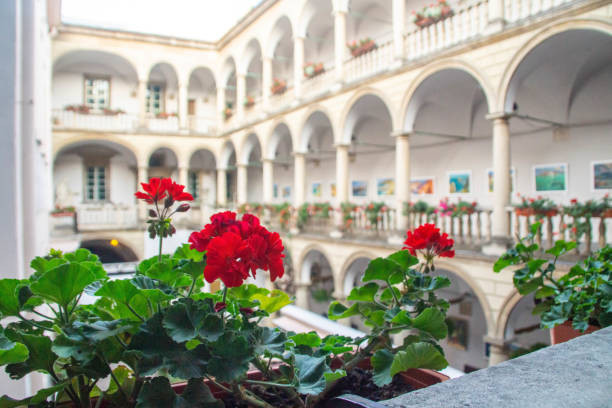
Lviv is a city that cannot be fully understood in a single visit. Every square and every stone house on Rynok Square has its own unique story, but the Italian Courtyard, located at Rynok Square 6, holds a special place in the heart of every traveler. It is not merely the inner space of the Korniakt Palace; it is a philosophical embodiment of the Renaissance, where the harmony of lines meets the grandeur of history. 🏛️
When you cross the threshold of this building, the noise of bustling Lviv instantly vanishes. You find yourself in an atmosphere of tranquility reminiscent of the 16th-century palaces of Florence or Venice. This site is unique in Eastern Europe, as it has preserved its authenticity almost in its original form, despite the wars and fires that have swept through the city over the centuries.
The Patron's Story: Constantine Korniakt's Ambition To understand why this courtyard is so magnificent, one must know the story of its founder. Constantine Korniakt was a Greek by birth who moved to Lviv and became the city's wealthiest merchant. He held a monopoly on the wine trade in the entire region, which allowed him to amass incredible wealth. However, in medieval Lviv, wealth did not always equate to status. There was a "three-window rule": only nobles could build houses three windows wide on the facade facing Rynok Square.
Korniakt, thanks to his connections with the royal court and financial support for the crown, received a unique privilege—to build a palace six windows wide. This was a direct challenge to the local aristocracy. To realize his vision, he invited Italian architects Pietro Barbon and Paolo Dominici (the Roman). They created a masterpiece where the inner courtyard became the central focus of the building. 🇮🇹

Architectural Features: The Three-Tiered Loggia The main element of the courtyard is its three-tiered open loggia. This architectural solution allowed the owners to enjoy fresh air while remaining inside the house. Three floors of galleries, decorated with columns and capitals, create a rhythmic pattern that fascinates the observer.
Each tier has its own specifics. The lower level served for household needs and passage. The second tier was an area for walks and conversations. The third tier is considered the most refined: its columns are thinner, and the space is filled with light. Due to the enclosed square of the building, a unique acoustic effect is created here. Sound reflects off the stone walls and arches, creating a voluminous effect. This is why today it hosts the best jazz and classical music concerts. 🎻
Treasures of the Italian Courtyard Today, the courtyard is part of the Lviv Historical Museum. Numerous artifacts telling the story of the city's past are on display. One of the most interesting exhibits is the stone lions. One of them once guarded the entrance to the Lviv City Hall. Its stern appearance serves as a reminder that Lviv has always been a city that knew how to defend itself.
You can also see the ancient "Isaiah" bell (1583), which is one of the oldest in the city. Its history is full of mysticism, having survived numerous sieges. Every stone in this courtyard is like a page in a book. Here you can see fragments of medieval columns, coats of arms of noble families, and epitaphs that transport us to the times of kings and knights. 🦁

Modern Life: Coffee and Tranquility Nowadays, the Italian Courtyard is not just a museum but also a place for relaxation. There is a cozy café where you can enjoy authentic Lviv coffee. This place is perfect for those who want to escape the tourist noise. At white marble tables, accompanied by jazz, time seems to stand still.
Many photographers consider this courtyard the best location for shoots. The play of light and shadow on the arcades creates ideal conditions for portrait photography. It is no wonder this courtyard has frequently appeared in films when directors needed to recreate the atmosphere of old Europe. 🍷
Conclusion The Italian Courtyard is a symbol of Lviv's aristocratism and European identity. It is a place where Greek ambition, Italian aesthetics, and Ukrainian hospitality merged into one. To visit Lviv and not step into the Italian Courtyard is like visiting Rome and not seeing the Colosseum. This place offers inspiration and makes one reflect on the eternity of art. 🏰
You can purchase medical insurance for entry into Ukraine on the website: welcomeukraine.today
Travel responsibly and explore new facets of Ukraine!
Going to Ukraine?
Medical insurance the border accepts — bought online, in your inbox in minutes.
Read next
All articles
Rosh Hashanah in Uman 2026: Dates, How to Get There and Travel Cost
Rosh Hashanah in Uman in 2026 will once again be one of the largest pilgrimage events of the year. Tens of thousands of pilgrims…

The Ukrainian Carpathians: What to See, How to Get There and How Much a Trip Costs
The Ukrainian Carpathians are a popular destination for foreign travelers who want to see mountains, forests, waterfalls, traditional…

Holidays in Prymorske and Vylkove (Odesa Region) in 2026: Peace, Nature and the Real Ukraine 🌊
Southern Odesa Region today is one of the few seaside destinations in Ukraine where you can still enjoy a peaceful, unhurried holiday. The…